
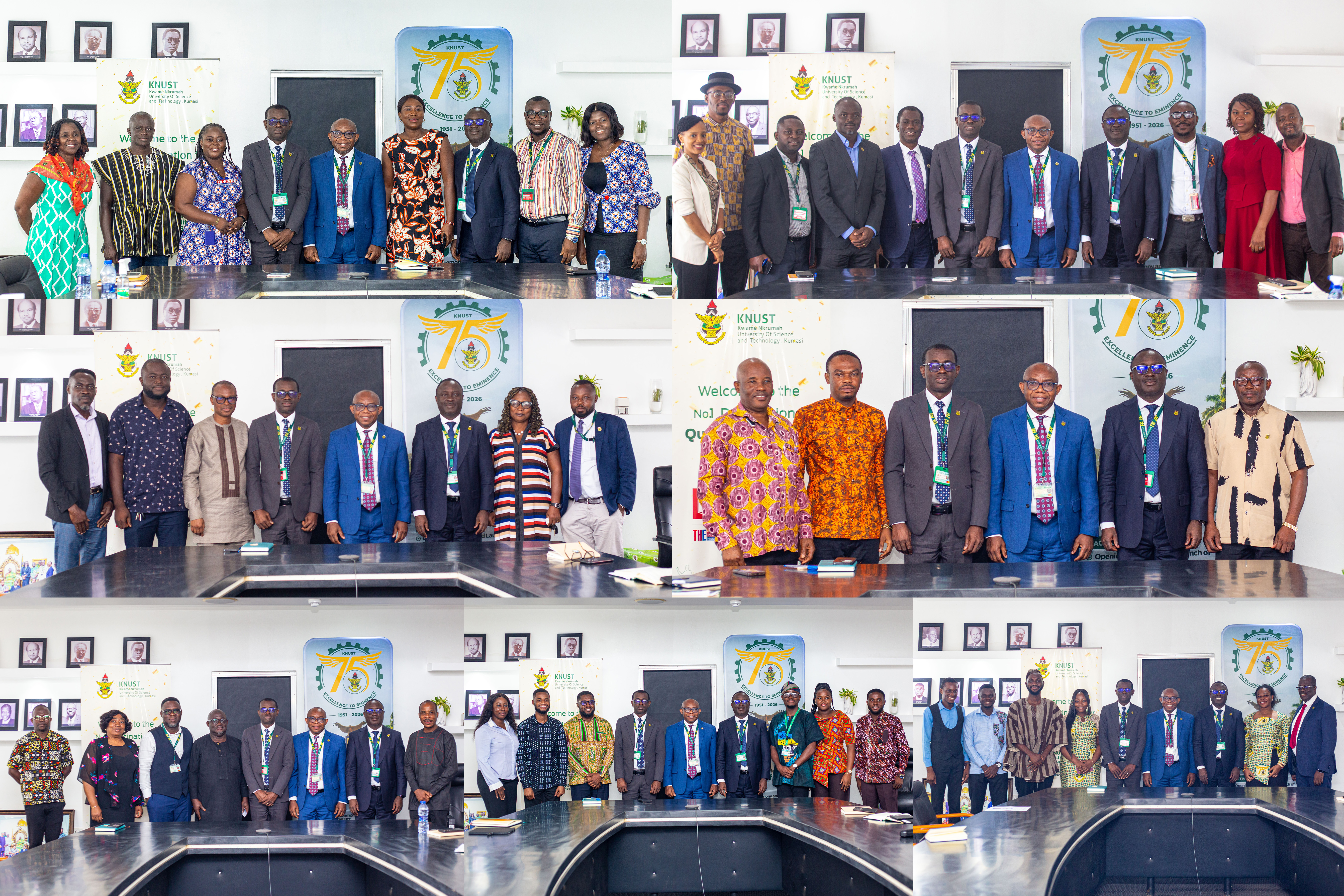
The Vice-Chancellor of the Kwame Nkrumah University of Science and Technology, Kumasi (KNUST), Professor Christian Agyare, has engaged executives of the University's labour unions and student leadership, reaffirming his commitment to collaborative leadership, transparency, staff and student welfare, and institutional transformation.
The engagements brought together executives of the University Teachers Association of Ghana (UTAG-KNUST), Ghana Association of University Administrators (GAUA-KNUST), Senior Staff Association of KNUST (SSAK), Teachers and Educational Workers' Union of the Trades Union Congress (TEWU-TUC), Tertiary Education Workers Union of Ghana (TEWU-GH), the Graduate Students' Association of Ghana (GRASAG-KNUST) and the Students' Representative Council (SRC).
Welcoming the various groups, Professor Agyare expressed appreciation for their support during his investiture and acknowledged the important role of staff and students in advancing the University's vision of moving from excellence to eminence.
"I believe we cannot be doing the same thing and expect different results," he said. "We are all part of this journey to move KNUST from excellence to eminence. It cannot be achieved by management alone; it requires the collective efforts and commitment of every member of the University community."
The Vice-Chancellor said his administration would prioritise inclusiveness, consultation and partnership, adding that the success of the University depends on the collective efforts of management, staff, students and other stakeholders.
During the interactions, executives of UTAG-KNUST, SSAK, TEWU-TUC and TEWU-GH congratulated Professor Agyare on his appointment and pledged their support for the successful implementation of his vision for KNUST.
The unions raised issues relating to staff welfare, promotion and recruitment, conditions of service, accommodation, transportation, infrastructure development, implementation of the traditional academic calendar and the ongoing review of the University's statutes. They also called for sustained consultation between management and organised labour on matters affecting staff.
Responding to the concerns, Professor Agyare assured the unions that management would continue to engage them in resolving issues within the University's mandate while collaborating with relevant government agencies on matters requiring national intervention.
He said his administration would remain guided by the University's Strategic Plan while focusing on seven key thematic areas: transformative education and organisational mindset development; entrepreneurship-driven research and innovation; quality management and human capital development; sustainable infrastructure for climate resilience; digital transformation through artificial intelligence; strategic collaborations and global visibility; and financial stewardship for long-term sustainability.
The Vice-Chancellor also met with executives of GRASAG-KNUST and the SRC, where discussions focused on strengthening graduate education, enhancing research excellence and innovation, and improving the overall student experience.
The GRASAG-KNUST leadership welcomed Professor Agyare's vision for the University and pledged its support while advocating increased research funding and grantsmanship training, improved research supervision and stronger alumni engagement to enhance graduate education and research outcomes.
The SRC executives also welcomed the Vice-Chancellor's vision and assured him of the student body's commitment to working collaboratively with management to promote a positive academic environment.
Professor Agyare reiterated his commitment to positioning graduate education at the centre of KNUST's research agenda.
"If we want to become a globally eminent university, our focus should increasingly be on graduate training because that enhances our research output and visibility," he said.
He added that universities must prepare students beyond the acquisition of academic certificates by equipping them with relevant skills and competencies for the world of work.
"People are no longer interested in certificates alone; they are interested in competencies. We must equip our students with the skills and knowledge that will prepare them for the world of work and enable them to create jobs rather than seek them," he said.
The Vice-Chancellor also urged students to uphold discipline and contribute to preserving the University's reputation, assuring them that management would continue to prioritise initiatives aimed at improving campus life and the student experience.
He said staff welfare would remain central to his administration, recognising employees' contributions as critical to achieving institutional excellence.
"The most important thing is the welfare of our staff. Whatever we do must ultimately improve the institution while ensuring that the welfare of our people is safeguarded," he said.
Professor Agyare assured all stakeholders that his administration would operate an open-door policy anchored on dialogue, mutual respect and inclusivity.
"Whatever challenges you have, you can share them with us, not only at today's meeting but through future engagements. We are going to have an open-door approach because management is here to listen to you," he said.
Story: Abigail Ofori


